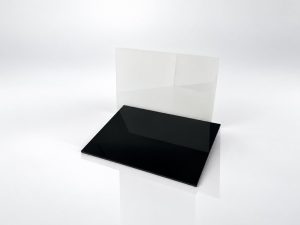
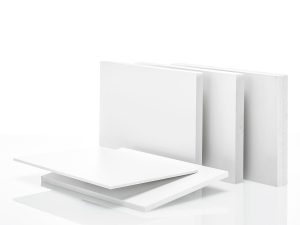
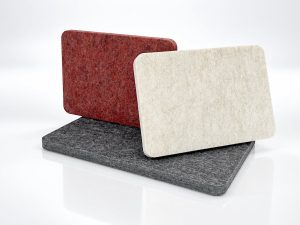
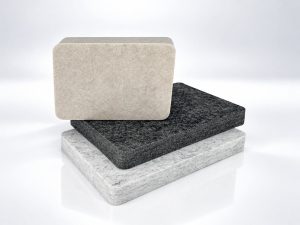
No editing
Drilling holes
4 holes in the corners, choose the diameter and the distance from the edge.
Round corners (contour milled)
Rounded corners, enter the radius (radius) in mm.
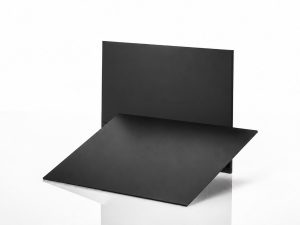
inflect
Bend the sheet.
Milling
Hole patterns, shapes, logos and engravings.
Lasers
Laser cutting and engraving of contours.
Digital cutting
Contours cut with a digital cutting machine.
In consultation: we will first discuss this with you.
Assemble
Assemble multiple sheets into one product.
UV print
Full color printing with UV ink.
Hole diameter
Choose
2
3
4
5
6
7
8
9
10
Hmm
We drill 4 holes, one in each corner, all the same distance from the edge. A different hole position? Add it to the comment and we will turn it into a quote.
Multiple options are available.
Supplying a file? Download the delivery specifications:
Bending and creasing
Plano can make a local line bend or crease, not a large uniform curve or fold. In the case of creases, the plate is locally heated and bent along a single straight line.
Sharp bend with a small inner radius, along a single line. The plate remains flat outside the bending zone.
An even radius across the plate. For a large curve, please contact us first.
What you provide
Choose inner dimensions or outer dimensions. The size of surface A and surface B, and the position of the fold line. The desired angle in degrees and the bending direction.
What you can expect
A tight bend with a small inner radius. Plano calculates based on the selected internal or external dimensions. The exact radius depends on the material and sheet thickness.
Please note Always explicitly write 'interior dimensions' or 'exterior dimensions' with the measurements. Without this choice, the dimensions are not unambiguous.
Brush and texture direction
For brushed or textured panels: link the direction to one dimension. Always state 'brushing direction parallel to dimension ... mm'. Only 'horizontal' or 'vertical' is not sufficient.
The structure runs horizontally, parallel to the long dimension. View the panel straight on (front side).
Same panel, vertical structure. Both are possible; that is why 'landscape' or 'portrait' is not enough and you state the size in mm.
What you provide
The two sheet sizes, for example 600 × 400 mm. The specific dimension along which the brush direction must run parallel. In case of equal dimensions: add a sketch with a directional arrow.
What you can expect
The structure runs parallel to the dimension you mentioned. The order confirmation shows the chosen parallel size.
Please note Do not use only 'horizontal', 'vertical', 'landscape' or 'portrait'. Always mention the corresponding size in millimeters.
Bonding
Choose the connection and indicate whether you are providing inside or outside dimensions. In the case of butt-joint gluing, Plano determines the production-technical structure.
One panel continues; the end grain of the other remains visible. Plano determines which part continues.
Both parts are given a bevel and meet at the corner, without an exposed end grain. A fine glue line may remain visible.
What you provide
Pay in full or by installments. Size A and size B, and whether those are inside dimensions or outside dimensions.
What you can expect
Stomp: Plane determines which part continues. Miter: a corner without an exposed end grain; a fine glue line may remain visible.
Please note Always state 'interior dimensions' or 'exterior dimensions'. Without that choice, the dimensions are not unambiguous.
Triangles and angled shapes
With only a hypotenuse or a scaled sketch, the shape is not unambiguous. Use the dimension letters: B = total base width, H = perpendicular height, X = apex position.
Symmetrical triangle: B = 200 mm, H = 350 mm. The apex lies exactly above the center of B.
Then also provide dimension X: the position of the top, measured from the bottom-left corner.
What you provide
B: the full base width. H: the perpendicular height, at right angles to the base. Top-centered: yes/no. If no, also dimension X from left.
What you can expect
W and H are used as the absolute outer dimensions. With 'centered', the top lies exactly above the center of B. At size X, the top is above the position you specified.
Please note Measure H is always perpendicular to the base, so not along a slanted side. In case of doubt, include a dimension sketch.
Drilling holes
Sawing + drilling: maximum 4 identical holes. All four holes have the same diameter and the same center-to-center position relative to the panel edges.
Panel 750 × 1000 mm with 4 equal holes: one diameter (e.g. 8 mm) and one center-to-center position (e.g. 20 mm, panel edge to center), automatically in all four corners.
More than 4 holes, different diameters or deviating hole positions: choose milling or laser cutting.
What you provide
The length and width of the panel. The diameter; this applies to all 4 holes. One center-to-center position; this applies to all 4 holes.
What you can expect
Maximum 4 holes for sawing + drilling processing. All holes have the same diameter and identical position. More or non-standard holes are milled or laser-cut.
Please note Do not specify individual hole coordinates. For a non-standard hole pattern, choose milling or laser cutting.
Note on your edits (optional)